
The bacteria in your septic system are living microorganisms that break down everything you flush, turning solid waste into liquid and gas so your tank does not clog.
Without them, a septic tank would fill with solids in a matter of weeks.
At Tampa Bay Septic, we tell homeowners to picture the tank as a quiet, around-the-clock workforce: keep the workers healthy, and the whole system runs for decades.
Harm them, and you invite backups, odors, and expensive repairs. This guide explains what these bacteria do, what kills them, how to protect them, whether additives are worth buying, and the warning signs that your tank’s biology is in trouble.
What Do Septic System Bacteria Actually Do?
Septic system bacteria digest the organic solids in household wastewater and convert them into three things: a floating scum layer, a middle layer of clarified liquid, and a bottom layer of sludge.
This biological process is the entire reason a conventional septic tank works without electricity or chemicals. As wastewater flows in, bacteria immediately begin feeding on the solid waste, shrinking it so the tank does not fill as fast.
The clarified liquid in the middle, called effluent, flows out to the drainfield, where a second community of microorganisms finishes treating it before it reaches the soil and groundwater.
The U.S. Environmental Protection Agency notes that a septic system “contains a collection of living organisms that digest and treat” household waste, which is why protecting that biology matters so much.
You can read the agency’s overview in the EPA’s guide to caring for your septic system.
Anaerobic and Aerobic Bacteria: The Two Workers
Two kinds of bacteria do the heavy lifting, and they live in different parts of the system:
- Anaerobic bacteria thrive without oxygen and dominate inside the sealed tank. They break down most of the solids and produce gases like methane as a byproduct.
- Aerobic bacteria need oxygen and do their work mainly in the drainfield soil or in the aeration chamber of an aerobic treatment unit. They polish the effluent and reduce harmful organisms.
If you have an aerobic treatment unit instead of a conventional tank, the balance shifts toward oxygen-loving microbes, which is why those systems use a pump to add air.
We cover that setup in our guide to aerobic septic tank function and care.
The Three Layers Bacteria Create
Inside a healthy tank, bacterial digestion sorts waste into a predictable structure:
- Scum floats on top (fats, oils, and grease, the bacteria break down slowly).
- Effluent sits in the middle (the clarified liquid that exits to the drainfield).
- Sludge settles on the bottom (the digested solids that bacteria cannot fully consume).
Bacteria shrink the sludge layer continuously, but they never eliminate it. That leftover sludge is exactly why every tank still needs periodic pumping, no matter how healthy its bacteria are.
What Kills the Bacteria in Your Septic Tank
The fastest way to damage a septic system is to send products down the drain that kill bacteria faster than the tank can rebuild them.
Your tank is a living habitat, and the same chemicals marketed to “kill 99.9% of germs” do not stop working once they leave your bathroom.
Common bacteria killers include:
- Bleach and antibacterial cleaners in large or frequent amounts. A normal, diluted splash is usually fine, but pouring bleach down drains daily or dumping concentrated cleaner overwhelms the colony.
- Drain cleaners and solvents. A single bottle of caustic drain opener can wipe out a meaningful share of the tank’s microbes.
- Antibacterial soaps, disinfectant wipes, and harsh toilet-bowl tablets are used constantly.
- Prescription medications and chemotherapy drugs pass through the body and into the wastewater.
- Too much water, too fast. Overloading the tank with laundry or long simultaneous showers flushes bacteria out to the drainfield before they finish working.
- Paint, pesticides, gasoline, and other household chemicals are poured down any drain.
How you clean your bathroom has a bigger effect than most people realize. We break it down further in how bathroom cleaning affects your septic tank.
The same caution applies in the kitchen, especially if you run a disposal, which is why we put together tips for using a garbage disposal with a septic tank.
How to Keep Your Septic Bacteria Healthy
Protecting your septic bacteria comes down to one rule: only send down the drain what bacteria can digest, and never overwhelm them. A few habits do almost all the work.
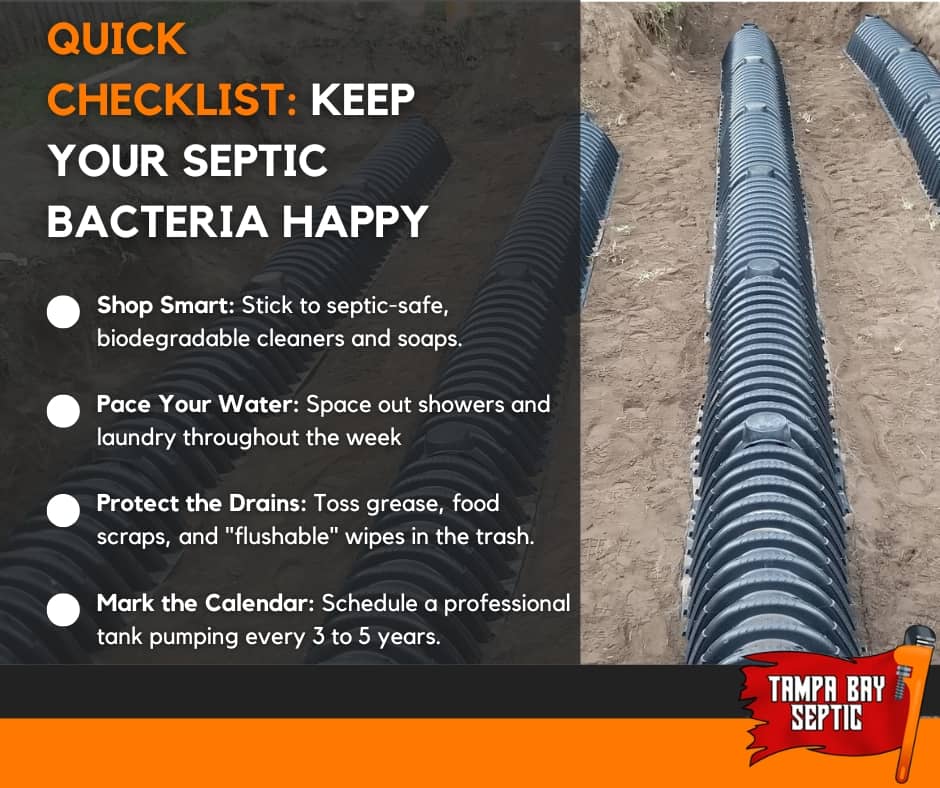
- Choose septic-safe, biodegradable products. Look for cleaners, detergents, and toilet paper labeled septic-safe. They do the job without flooding the tank with bacteria-killing ingredients.
- Spread out water use. Run laundry across the week instead of five loads on Saturday. Fix running toilets and dripping faucets, which quietly flood the tank.
- Keep food, grease, and “flushable” wipes out. Grease coats the scum layer, and wipes never break down. Both starve and clog the system.
- Pump on schedule. Most households need pumping every three to five years. Pumping removes the sludge that bacteria cannot digest and gives the colony a clean home to keep working. This is a guideline, not a Florida mandate for conventional systems, but skipping it is the most common cause of failure.
- Protect the drainfield. Do not park, pave, or plant deep-rooted trees over it, and keep oxygen flowing to the aerobic bacteria in the soil.
When your tank is finally pumped, you do not need to “save” old sludge or add anything to restart the bacteria. A normal household reseeds the tank naturally within days.
If you are unsure when your tank was last serviced, our guide on whether you need a septic clean-out walks through the signs.
Do Septic Tank Additives Actually Work?
For most homeowners, septic tank additives are not necessary, and the EPA has found they do not improve the performance of a healthy system.
A working tank already grows all the bacteria it needs from the waste you put into it.
The additive industry markets monthly bacteria and enzyme products as routine maintenance, but a healthy tank is food-limited, not bacteria-limited, so adding more microbes mostly creates competition rather than faster digestion.
The EPA lays this out in its septic tank additives fact sheet.
Here is how the common options compare:
| Option | What it claims | Reality for a healthy tank |
|---|---|---|
| Biological additives (bacteria/enzymes) | “Boost” digestion monthly | Not needed; tank self-seeds. Possible narrow use: reseeding after a chemical kill-off |
| Inorganic/chemical additives (acids, alkalis) | Dissolve clogs | Can corrode the tank and harm the drainfield. Avoid |
| DIY recipes (yeast, sugar, raw meat) | Cheap bacteria boost | Folklore, not proven. Yeast does not replace true digestion |
| Doing nothing but maintaining the system | No product needed | The approach the EPA supports for healthy tanks |
The one time additives can help is after something kills the colony, for example a big dose of drain cleaner or a course of strong antibiotics.
Even then, the fix is to stop the source of harm first, then let the tank recover, with reseeding as an optional boost.
Signs Your Septic Bacteria Are Struggling
When septic bacteria fall behind, the system tells you before it fails completely. Watch for these warning signs:
- Slow drains and gurgling pipes throughout the house, not just one fixture.
- Sewage odors indoors, near the tank, or over the drainfield.
- Soggy, unusually green grass above the drainfield is a sign that effluent is not being treated.
- Backups in the lowest drains or toilets.
- Solids carry over to the drainfield, which a technician can spot during service.
Florida homeowners face an added challenge. Our high seasonal water table, often just two to four feet below the surface, and heavy summer rain can saturate the soil around a drainfield.
When the ground is waterlogged, oxygen drops, and the aerobic bacteria in the soil slow down, so a system that seems fine in the dry season can struggle after a storm.
Drainage problems on a property make this worse, the same way that standing groundwater stresses a foundation. For homeowners dealing with that kind of moisture intrusion, this overview of water pooling in a crawl space shows how persistent groundwater finds its way in.
If you want to understand the soil-treatment side of your own system, see our explainer on the leach field area of a septic system.

Related Questions to Explore
What kills the bacteria in a septic tank?
Bleach and antibacterial cleaners in large amounts, caustic drain cleaners, solvents, paint, pesticides, and some medications all kill septic bacteria. Overloading the tank with too much water at once also flushes bacteria out before they finish digesting waste.
Do you need to add bacteria to your septic tank?
Usually no. A healthy tank grows the bacteria it needs from normal household waste, and the EPA has found that additives do not improve a working system. Adding bacteria only helps in the narrow case of restarting a tank after a chemical or antibiotic kill-off.
What are the signs of low bacteria in a septic tank?
Slow drains, gurgling pipes, sewage odors, backups, and soggy or unusually green grass over the drainfield all point to bacteria that are not keeping up. If you notice several at once, the tank likely needs service. A septic inspection is also a standard part of buying a home, as Georgia inspectors explain in what a home inspection covers.
Does bleach hurt your septic system?
Small, diluted amounts of bleach from normal cleaning will not destroy your tank’s bacteria. The problem is frequent or concentrated use, like pouring bleach down drains daily, which kills more microbes than the tank can rebuild. Choose septic-safe products for regular cleaning.
How can I increase the bacteria in my septic tank naturally?
The most reliable way is to stop killing them: switch to septic-safe products, spread out water use, and keep grease, chemicals, and wipes out of the drains. A normally used household reseeds its own tank. Septic bacteria are also part of the larger groundwater quality, the same concern behind testing for issues like safe radon levels indoors and well-water contaminants.
When to Call a Professional
If you see repeated backups, persistent odors, or standing water over the drainfield, call a septic professional rather than reaching for an additive.
Those symptoms usually mean the tank needs pumping or the drainfield needs attention, and no product fixes a full tank or a failing field.
A technician can measure your sludge and scum layers, confirm whether the bacteria are healthy, and catch small problems before they become a system replacement.
Tampa Bay Septic has served Tampa Bay homeowners for more than 25 years and is registered with the Florida Department of Health.
We offer emergency service and a best-price guarantee, and we serve the greater Tampa area, including Hillsborough, Pinellas, and Pasco counties.
If your system is overdue for service or showing warning signs, you can request a quote or schedule service, and we will take a look.
Conclusion
Your septic system runs on living bacteria, and protecting them is the cheapest maintenance you can do. Keep these takeaways in mind:
- Septic bacteria break down waste continuously, but they still leave sludge that must be pumped every three to five years.
- Harsh chemicals, antibacterial products, and overloading the tank with water are the fastest ways to kill them.
- Additives are not necessary for a healthy tank; good habits and regular pumping do the real work.
For service that keeps your tank’s biology healthy, learn more about our septic tank pumping and cleaning, and reach out anytime. A little care today protects your property, your wallet, and the groundwater around you.

