
A septic tank riser is a vertical pipe that connects your underground tank’s access port to ground level, so your technician can open the lid and service the system without digging up your yard every time.
At Tampa Bay Septic, we install risers on a regular basis, and we recommend them to most homeowners whose tanks are still buried under grass and soil. This post covers what risers do, what they cost in Florida, the different types available, and how to know if your system needs one.
What Does a Septic Tank Riser Do?
Most septic tanks are buried 12 to 36 inches below the surface. Without a riser, a technician has to locate the tank, dig down to the lid, pump or inspect the system, and then backfill the hole. That process takes extra time, adds labor cost to every service call, and tears up the same patch of lawn every few years.
A riser eliminates all of that. It attaches directly to the access port on top of your tank and extends upward to the surface, where a sealed lid sits flush with or slightly above your yard. When service is due, the technician walks straight to the lid and opens it. No digging required.
Florida has over 2.5 million septic systems in use, according to the Florida Department of Environmental Protection.
A large share of those (especially in older Tampa Bay neighborhoods) were installed before risers were standard. That means many homeowners are still paying digging fees on every service visit without realizing a one-time fix exists.
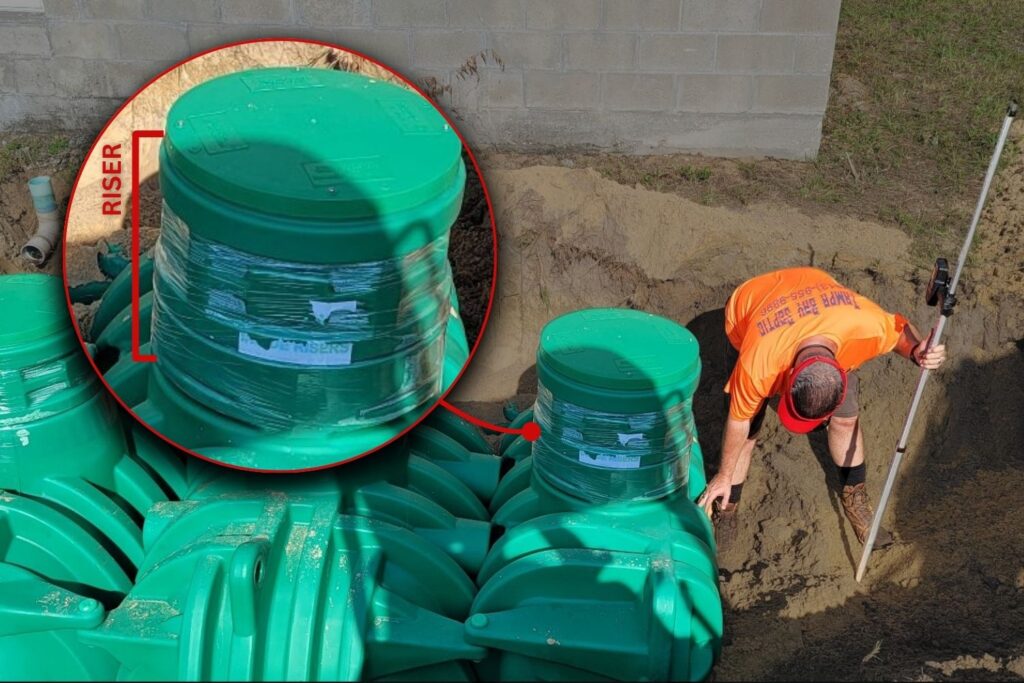
Types of Septic Tank Risers
Risers come in three main materials. Each has tradeoffs worth knowing before installation.
PVC Risers
PVC risers are the most common choice for residential retrofits. They are lightweight, easy to cut to the right height, and fully watertight when properly sealed. PVC holds up well in Florida’s wet conditions and does not corrode. Most residential installations use PVC.
Polyethylene (HDPE) Risers
Polyethylene risers are similar to PVC in durability and weight but are slightly more flexible and impact-resistant.
They are a common choice for newer systems and handle soil movement well, which matters in Tampa Bay’s sandy, shifting ground. HDPE risers are also watertight and available in larger diameters for tanks with wider access openings.
Concrete Risers
Concrete risers are heavier and less commonly used for retrofits. They were more standard on older installations and are still found on systems that have been in place for decades. Concrete is durable but can crack over time and is harder to seal against groundwater infiltration.
If your current system has a concrete riser that is leaking or cracked, replacing it with PVC or polyethylene is usually the better long-term call.
Benefits of Installing a Riser on Your Tampa Bay Home
The practical case for a riser comes down to four things:
1) No digging on every service visit. Once a riser is in place, pumping, inspection, and any access work goes straight through the lid. Your technician is in and out faster, and your yard stays intact.
2) Lower cost over time. Riser installation runs $300 to $1,000 as a one-time expense in Florida, depending on tank depth and material. That cost pays for itself within a few service cycles by eliminating excavation labor fees, which typically run $50 to $150 per visit.
3) Reduced lawn damage. In Tampa Bay, the combination of sandy soil and heavy seasonal rain makes repeated digging hard on a yard. Compacted soil and ruts around the tank area can become a real issue over years of service without a riser. Risers contain all access to one small footprint.
4) Easier emergency response. If your system backs up or shows warning signs, fast access matters. A riser means a technician can respond and get to work immediately rather than spending time locating and digging up the tank first.
How Much Does a Septic Tank Riser Cost in Florida?
Riser installation in Florida typically falls between $300 and $1,000 for most residential systems. The cost range reflects:
- Tank depth: A deeper tank requires a taller riser, which costs more in materials and slightly more in labor
- Material choice: PVC and polyethylene cost less than concrete; polyethylene is mid-range
- New vs. retrofit: Adding a riser to a brand-new installation is cheaper than retrofitting one onto an existing buried system, since the tank is already accessible during installation
- Number of access ports: Some tanks have two openings (inlet and outlet). Putting risers on both costs more but gives complete access to the full system
The investment is a one-time charge. Across 10 to 15 years of regular septic tank pumping and maintenance, the savings on excavation fees generally exceed the installation cost several times over.
Do You Need One?
If your tank is currently buried without a riser, the honest answer for most Tampa Bay homeowners is yes. Here is a simple way to think about it:
- If your last service call required digging, you don’t have one
- If you don’t know where your tank is located on your property, you definitely don’t have one
- If your tank hasn’t been serviced in more than three years, this is a good time to add a riser at the same appointment
The only situations where a riser may not be worth it: if your tank is already close to the surface with a concrete lid that is easy to access, or if you are planning a full system replacement in the near future anyway.
Risers are not required by Florida law for existing systems, but they are for new installations and are strongly recommended during any maintenance or upgrade appointment.

Related Questions to Explore
Is a septic tank riser required by law in Florida?
Florida does not require risers on existing residential septic systems. However, most new installations include them automatically, and they are recommended by the Florida DEP as part of keeping systems accessible for regular maintenance. Some municipalities may have additional requirements. Your technician can confirm what applies to your county.
Can a riser be added to an older septic tank?
Yes. Nearly all residential septic tanks (regardless of age or depth) can be retrofitted with a riser. A technician will confirm the right diameter and material based on your tank’s access port size and how deep it sits. It is one of the most straightforward upgrades to add during a scheduled septic tank inspection or pump-out.
Will a riser affect how often I need to pump my tank?
No. A riser changes how your tank is accessed, not how the system functions. Your pumping schedule stays the same: every three to five years for most Tampa Bay households, or every three years as a baseline per the Florida DEP. What changes is that staying on that schedule becomes much easier and less disruptive.
What happens if a septic tank riser lid is damaged or missing?
A damaged or missing riser lid is a safety issue and should be addressed quickly. An open or broken lid creates a fall hazard and allows surface water, debris, and pests to enter the tank. If you notice a cracked, sunken, or missing riser lid on your property, call a septic contractor to replace it before your next scheduled service. Tampa Bay Septic can replace lids and inspect the riser for any seal issues at the same visit.
When to Call a Professional
If any of the following are true for your property, it’s worth having a licensed septic contractor take a look:
- You’ve never had a riser installed, and every service call has required digging
- You don’t know where your tank is located or how deep it sits
- Your riser lid is cracked, sunken, or doesn’t seal properly
- You are buying or selling a home and want to know the access condition of the system
- Your tank hasn’t been pumped in the last three to five years, and you want to add a riser at the same appointment
A riser can be added during most standard service visits without scheduling a separate trip. Tampa Bay Septic serves Hillsborough County and northern Manatee County.
Conclusion
A septic tank riser is a straightforward upgrade that makes every future service visit faster, cheaper, and easier on your yard. For most Tampa Bay homeowners with older buried tanks, it is one of the better investments you can make in your system’s long-term maintenance.
Key takeaways:
- A riser extends your tank’s access port to the surface so technicians never have to dig
- Installation costs $300 to $1,000 in Florida and pays for itself over time through saved excavation fees
- Risers can be retrofitted on almost any existing system, often at the same appointment as a pump-out
Tampa Bay Septic installs risers on residential and commercial systems throughout the Tampa Bay area. See our full range of septic services or get in touch to schedule your next service appointment.

![FAQs about Septic Systems [infographic]](https://tampabayseptic.com/wp-content/uploads/2020/10/124766-Tampa-Bay-Septic_Approved-feat.jpg)