
A septic tank baffle is a barrier at the tank’s inlet and outlet openings that controls how wastewater moves through the tank, so solids stay behind and only clarified liquid flows out to the drainfield.
Most tanks have two of them. When one breaks, you often have no idea until a pumping truck shows up and the technician says the words no homeowner wants to hear.
At Tampa Bay Septic, our crews find failed baffles in Florida tanks constantly, and the outlet side is almost always the expensive one.
Here is what a baffle does, how to spot one that has gone bad, what Florida requires for the repair, and what it costs to fix.
What Is a Septic Tank Baffle?
A baffle is a wall or pipe fitting that forces wastewater to take an indirect path through your tank. That short detour is what makes the whole system work.
Sewage entering the tank separates into three layers: a floating scum layer of grease and soap on top, water in the middle, and a sludge layer of settled solids on the bottom.
Baffles hold the top and bottom layers in place so only the clean middle water leaves.
Older Florida tanks have baffles cast directly into the concrete. Newer tanks and repaired tanks use a PVC sanitary tee, sometimes called a PVC-T baffle, bolted or grouted into the opening. Both do the same job.
Your tank has two, and they fail in very different ways. Our simple septic tank diagram breaks down where each one sits relative to the rest of your system.
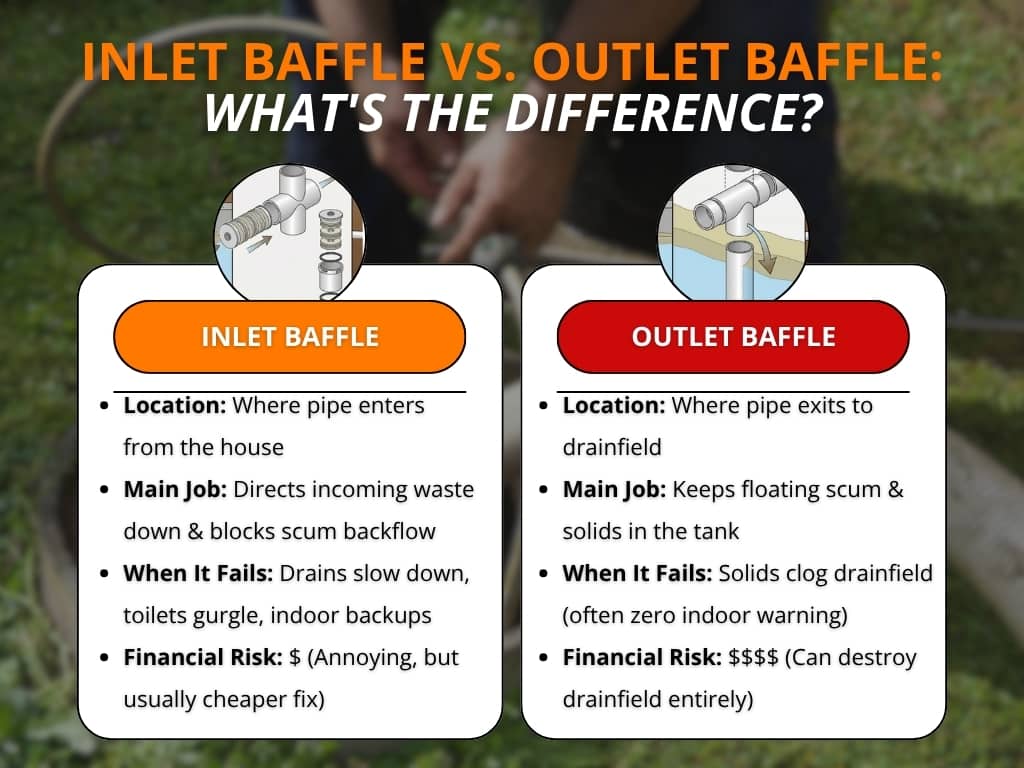
The Inlet Baffle
The inlet baffle sits where the pipe from your house enters the tank. It points incoming wastewater downward so the flow does not splash across the surface and stir up the scum layer.
It also keeps that scum from drifting back up the pipe toward your house.
When the inlet baffle breaks, the problems show up indoors: slow drains, gurgling fixtures, and eventually backups. Annoying, but usually the cheaper of the two failures.
The Outlet Baffle
The outlet baffle sits at the pipe leaving the tank, and it extends below the water line, deeper than the inlet.
That depth is the whole point. It draws water from the middle of the tank, below the floating scum and above the settled solids, so only clarified effluent reaches your drainfield.
Florida’s septic code is specific about this geometry. Under FAC 62-6.013, the outlet device invert must sit between 30 and 40 percent of the liquid depth below the liquid level, and be at least 4 inches in diameter.
A tee installed at the wrong depth is a code failure even if it looks fine from above.
Outlet baffle failure is the one that costs real money, because there is nothing left to stop grease and solids from flowing straight into your drainfield.
Baffle, Sanitary Tee, or Effluent Filter? Clearing Up the Terms
These three get used interchangeably, and they are not the same thing. Getting them straight matters when you are reading a repair estimate.
| Component | What it is | What it does | Required? |
|---|---|---|---|
| Concrete baffle | A wall cast into the tank at the inlet or outlet | Redirects flow, holds back scum and solids | Yes, in original tanks |
| Sanitary tee (PVC-T) | A T-shaped PVC fitting installed in the opening | Same job as a concrete baffle, modern replacement | Yes, as a baffle replacement |
| Effluent filter | A cartridge that slides into the outlet tee | Screens fine particles from effluent leaving the tank | No, an optional upgrade |
Two things to hold onto. First, a baffle does not filter anything. It redirects flow and traps floating scum by physics rather than by screening.
Second, an effluent filter is not a substitute for a baffle. A filter needs a functioning outlet tee to mount in. If a technician quotes you a filter to solve a missing baffle, ask questions.
One more source of confusion: in a two-compartment tank, the wall between compartments is sometimes called a baffle.
That is a dividing wall, and it is a different component with a different failure mode.
Why Do Septic Baffles Fail in Florida Tanks?
Concrete baffles fail because of a chemical reaction, not wear and tear. The gas above the water in your tank is heavy with hydrogen sulfide.
Where that gas meets moisture and oxygen at the top of the tank, bacteria convert it into sulfuric acid, and that acid eats concrete from the top down.
The baffle takes the worst of it, because it sits right at the waterline in the most gas-saturated part of the tank.
That is why crews so often open a Florida tank and find a crumbling stub, or nothing at all where a baffle used to be. A missing baffle does not mean the tank never had one.
| Baffle material | Typical service life | Fails by |
|---|---|---|
| Cast concrete | 15 to 20 years | Sulfuric acid corrosion, crumbling, collapse |
| Steel (very old tanks) | 15 to 25 years | Rust-through |
| PVC sanitary tee | 30 to 50+ years | Rarely fails, can loosen at the grout |
Florida adds its own pressure. Roughly 30 percent of the state’s population is on septic, and the Florida Department of Health’s onsite sewage program exists largely because groundwater supplies about 90 percent of Florida’s drinking water.
Our high water table and shallow, sandy soils mean drainfields already run close to their limits, so a baffle failure here does more damage faster than the same failure in a drier state.
Rainy season and hurricanes make it worse. When soil around the tank is saturated, effluent has nowhere to go and backs up into the tank.
One important warning: do not have your tank pumped while the surrounding soil is saturated. An empty tank in waterlogged ground can float and lift out of position.
What Are the Signs of a Broken Septic Tank Baffle?
The signs split cleanly by which baffle failed, which is genuinely useful for narrowing down what you are dealing with before anyone digs.
| What you notice | Likely culprit | Why |
|---|---|---|
| Slow drains and gurgling throughout the house | Inlet baffle | Scum drifting back into the inlet pipe restricts flow |
| Toilet bubbling when other fixtures run | Inlet baffle | Blocked venting and flow at the tank inlet |
| Sewage odor near the tank | Either | Disturbed layers release more gas |
| Soggy or unusually lush grass over the drainfield | Outlet baffle | Solids reaching the field and clogging it |
| Standing water or effluent surfacing in the yard | Outlet baffle | Drainfield can no longer absorb |
| Pumper reports a thick scum layer sitting below the outlet | Outlet baffle | Scum being drawn into the outlet pipe |
| Repeat backups shortly after a pump-out | Outlet baffle | Field is clogging, not the tank filling |
That last row is the one homeowners misread most often. If your tank was just pumped and you are backing up again within weeks, the tank is usually not the problem.
The drainfield is, and a failed outlet baffle is a common reason why. We cover the broader symptom list in our post on why your toilet might be bubbling.
Here is the hard part: an outlet baffle can be completely gone with zero symptoms for a year or more. Damage accumulates silently in the drainfield while everything indoors works normally.
That is exactly why baffle condition gets checked at every routine service visit.
How Can You Check Your Baffle From Ground Level?
You can get a reasonable look at your outlet baffle without opening anything up if you have a riser with an accessible lid. Never enter or lean into a septic tank.
The gases inside are lethal, and tanks are a confined space, so this is a look-only inspection.
- Locate the outlet-side lid or riser. The outlet is on the side of the tank facing your drainfield. If you have not installed risers yet, our post on septic tank risers explains why they make checks like this possible.
- Open the lid and step back for a minute. Let the gas clear before you look in. Stay upwind.
- Shine a bright flashlight at the outlet opening. Use your phone camera on video and hold it above the opening rather than putting your head over it.
- Look for the tee. A healthy outlet has a visible PVC tee or a solid concrete lip framing the opening. Look for a clean vertical drop below the waterline.
- Look for what should not be there. A crumbling stub, exposed rebar, concrete chunks on the tank floor, or an open pipe with nothing in front of it all point to a failed baffle.
- Check the liquid level. Water should sit right at the bottom of the outlet pipe. Noticeably higher usually means a drainfield problem, not a baffle problem.
- Check where the scum sits. If the floating layer extends down past the top of the outlet opening, scum is being pulled into your drainfield right now.
Take photos and close the lid securely. If anything looks wrong, or you cannot tell, that is the point to bring in a professional rather than reaching in.

What Happens to Your Drainfield When the Outlet Baffle Fails?
Grease and solids entering the drainfield coat the soil and feed an impermeable layer called a biomat. The soil stops absorbing. Roughly, here is how that progresses in Tampa Bay conditions:
- Months 1 to 6: Solids begin coating the distribution lines and the top of the soil in the trenches. No symptoms indoors.
- Months 6 to 18: Absorption drops. Grass over the field gets greener and spongier. Effluent lingers in the trenches.
- Months 18 to 36: Standing water or surfacing effluent. Backups return quickly after each pump-out.
- Beyond that: Partial or full drainfield replacement, typically the most expensive repair in a septic system by a wide margin.
The important and unwelcome part: biomat damage is not reversible by pumping. Once sandy Pinellas and Hillsborough soils are greased, they stay bound up.
Replacing the baffle stops new damage immediately, but it does not undo what has already happened.
This is why a $400 repair postponed for two years turns into a five-figure one. Our drainfield repair and maintenance page covers what recovery options exist once a field is compromised.
What Does Baffle Replacement Cost, and Do You Need a Permit in Florida?
Baffle replacement is one of the least expensive repairs your septic system will need, which is what makes deferring it such a bad trade.
| Scenario | Typical range |
|---|---|
| PVC tee installed during a scheduled pump-out, with accessible risers | $150 to $600 |
| Replacement requiring lid location and excavation | $500 to $1,500+ |
| Both baffles replaced at once | Add roughly 30 to 50 percent to the above |
| Optional effluent filter added at the same time | $100 to $300 |
| Drainfield replacement after prolonged neglect | Many thousands |
The single biggest cost variable is access. If your lids are buried, most of what you pay is digging. That is the strongest financial argument for installing risers during your next service visit.
On permitting: do not assume baffle work is permit-exempt.
Since July 1, 2021, the Florida Department of Environmental Protection administers the onsite sewage program, and permitting for Tampa Bay counties still runs through local county health department offices.
Requirements vary by county and by the scope of the repair, and a licensed contractor handles the paperwork as part of the job.
Anyone telling you no permit is ever needed for tank repairs statewide is guessing.
Cost is also why we offer financing through Hearth, including 0 percent options for up to six months on qualifying repairs.
Common Questions Homeowners Ask
Do all septic tanks have baffles?
Effectively yes. Every conventional septic tank is designed with an inlet and outlet baffle, and Florida code requires a compliant outlet device. What varies is whether yours is still intact. Concrete baffles corrode away, so plenty of older Florida tanks currently have none. Some plastic and fiberglass tanks and aerobic treatment units use integrated tees or different outlet configurations, but the function is always present in the design.
Can I replace a septic baffle myself?
We strongly advise against it, for two reasons. Septic tanks are confined spaces with lethal gas, and people die attempting exactly this repair every year. Beyond safety, Florida code dictates the outlet device’s depth and diameter, and a tee set at the wrong depth is both a code violation and functionally useless. The tank also needs to be pumped first. Add all of that up and the DIY savings are small.
How long do septic baffles last?
Cast concrete baffles typically last 15 to 20 years in Florida before acid corrosion becomes serious. PVC sanitary tees last 30 to 50 years or more. If your tank is original and 20-plus years old and has never been repaired, assume the baffles need eyes on them.
Does a missing baffle fail a septic inspection when selling a house?
It will absolutely be written up on an inspection report, and buyers routinely ask for it to be corrected before closing. That said, Florida has no statewide point-of-sale septic inspection requirement, so a missing baffle does not automatically block a transaction the way it would in some states. Practically, it is a cheap repair that removes a negotiating point, so most sellers just fix it. Our septic tank inspection service covers baffle condition as a standard checklist item.
When to Call a Professional
Call a licensed septic contractor when any of these apply:
- Your last pumping report noted a damaged, deteriorated, or missing baffle
- Your tank is 15 years or older and has never had its baffles inspected
- Drains are slow or gurgling across multiple fixtures at once
- Grass over the drainfield is soggy, spongy, or noticeably greener than the rest of the yard
- Backups return within weeks of a pump-out
- You looked into the outlet riser and saw crumbling concrete, an open pipe, or scum below the outlet
- You are buying or selling a home with a septic system
The EPA recommends having your system inspected every one to three years and pumped every three to five. Baffle condition is checked during those visits, which is why a routine service call catches this before it turns into a drainfield problem.
Tampa Bay Septic has 25-plus years of hands-on septic experience across 24 Tampa Bay area communities, and we are registered with the Florida Department of Health.
Every service call includes a baffle check, so if yours is failing, you will hear about it while the fix is still measured in hundreds of dollars.
We offer weekend emergency service, after-hours repair, and a best-price guarantee against any competitor.
Conclusion
- A septic tank baffle keeps solids and scum in your tank so only clarified effluent reaches your drainfield. Your tank has two, and the outlet one is the expensive one to lose.
- Concrete baffles corrode from hydrogen sulfide gas and typically fail at 15 to 20 years, often with no symptoms while your drainfield quietly clogs.
- Replacement is cheap and permanent. Drainfield replacement after years of neglect is not, and the soil damage does not reverse.
Not sure when your baffles were last looked at? Our septic tank repair team can inspect and replace a failed baffle during a single visit, usually while the tank is already open for pumping.
Call us or request a quote, and we will take a look.

![FAQs about Septic Systems [infographic]](https://tampabayseptic.com/wp-content/uploads/2020/10/124766-Tampa-Bay-Septic_Approved-feat.jpg)